
Scouting has always come down to one question: can you separate a real signal from a busy schedule and forty-two thousand names? For the last several months, our team has been building the answer inside a single platform — EliteScoutIQ — and today we're opening it up to every student on the Elite Football Scouting Course.
It's not a stats site bolted onto a highlight reel. It's a working scouting desk: reporting, filtering, discovery, comparison, AI-assisted search, and squad planning, all reading from the same database.
Structured Reporting That Keeps Every Scout Comparable
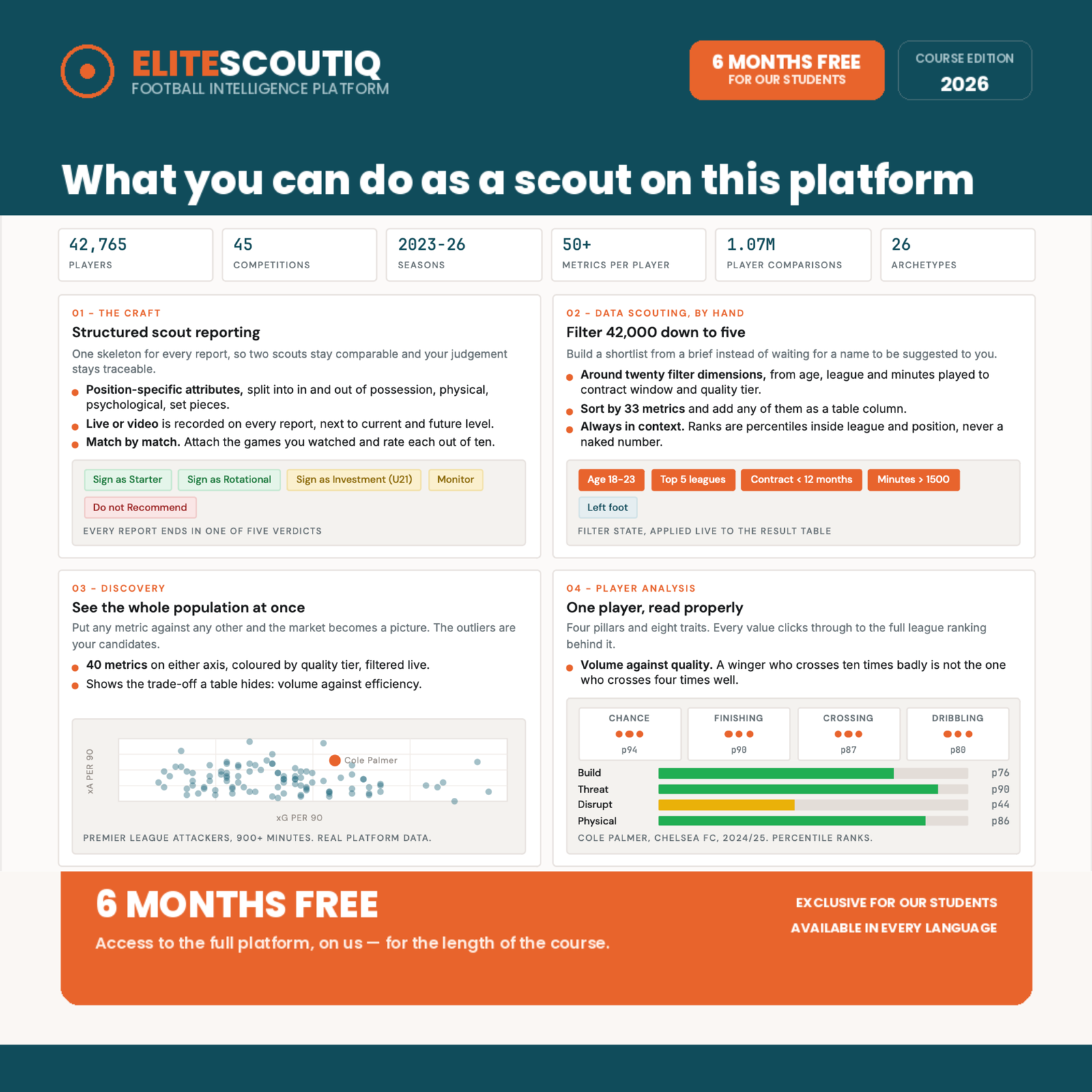
Every report on the platform runs off one skeleton: position-specific attributes split into in-possession, out-of-possession, physical, psychological, and set-piece categories, whether the viewing was live or on video, and a match-by-match log where you attach the game and rate it out of ten. Every report closes with one of five clear verdicts — Sign as Starter, Sign as Rotational, Sign as Investment (U21), Monitor, or Do not Recommend — so two scouts working the same list stay directly comparable, and your judgement stays traceable months later.
Filtering 42,000 Players Down to Five
Rather than waiting for a name to land in your inbox, you build a shortlist from a brief. Around twenty filter dimensions cover age, league, minutes played, contract window, and quality tier; you can sort by 33 metrics and pin any of them as a table column. Every number stays in context, too — ranks are shown as percentiles inside league and position, never as a naked figure that means nothing without a comparison point.
Seeing the Whole Population at Once
The discovery view plots any of 40 metrics against any other, coloured by quality tier and filtered live, which turns the market into a picture rather than a spreadsheet. It's built to surface the trade-off a table hides — volume against efficiency — so the outliers on the chart become your actual candidates instead of the ones an algorithm already flagged for you.
Reading One Player Properly
Individual player analysis is organised around four pillars — Build, Threat, Disrupt, Physical — and eight underlying traits such as chance creation, finishing, crossing, and dribbling, each shown as a percentile. The point isn't just volume: a winger who crosses the ball ten times badly is not the same player as one who crosses it four times well, and the platform is built to show that difference at a glance, with every value clicking through to the full league ranking behind it.
Structured reporting, live filtering across 42,000+ players, discovery scatter plots, and percentile-based player analysis — EliteScoutIQ turns raw data into a scouting decision, not just a dashboard.
Finding Players Who Play Alike
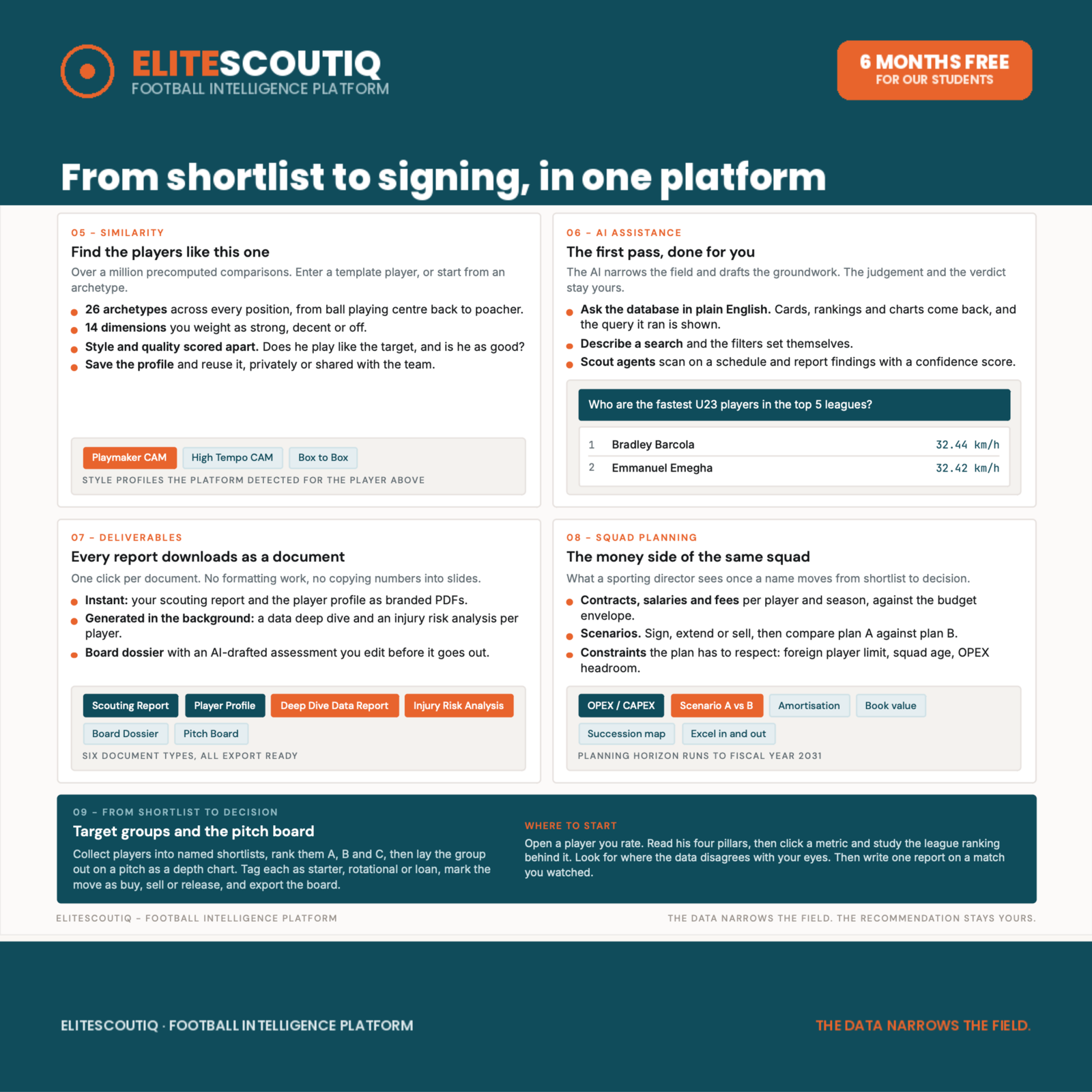
Once you've settled on a template player, the similarity engine draws on over a million precomputed comparisons across 26 archetypes, from the ball-playing centre-back to the classic poacher. You weight 14 dimensions as strong, decent, or off, and the platform scores style and quality separately — does this player play like the target, and separately, is he actually as good — before you save the profile to reuse privately or share with the wider team.
AI That Does the First Pass, Not the Judgement
You can ask the database questions in plain English — "who are the fastest U23 players in the top five leagues?" — and get back cards, rankings, and charts, along with the underlying query, so nothing is a black box. Describe a search and the filters set themselves; scout agents can even scan on a schedule and report findings with a confidence score attached. The AI narrows the field and drafts the groundwork. The recommendation, and the verdict, stay yours.
From Shortlist to a Document You Can Send
Every scouting report and player profile exports instantly as a branded PDF, with a data deep-dive and injury risk analysis generated in the background, plus a board dossier with an AI-drafted assessment you can edit before it goes out — six document types in total, all export-ready with no formatting work on your end.
Where Scouting Meets the Budget
The same platform carries the money side of the same squad: contracts, salaries, and fees per player and season set against a budget envelope, sign/extend/sell scenarios you can compare side by side, and the constraints a real plan has to respect — foreign player limits, squad age, OPEX headroom — with a planning horizon that runs out to fiscal year 2031.
Shortlists themselves get collected into named target groups, ranked A, B, and C, then laid out on a pitch as a depth chart — tagged starter, rotational, or loan, and marked buy, sell, or release before the whole board exports.
Free for Six Months, Starting the Day You Graduate
Every student who completes the Elite Football Scouting Course unlocks six months of full platform access at no cost, beginning the moment the course finishes — available in every language the course is offered in. That timing is deliberate. EliteScoutIQ isn't meant to be a study aid you close the day you get your certificate; it's meant to be there through the part that actually matters — the job search. While you're applying to clubs, agencies, and analytics departments, you'll have live shortlists, structured reports, and data-backed player profiles ready to show, not just a certificate to describe. That's a real advantage over other candidates walking into the same interview with a CV and nothing to open on a laptop.